Most people picture a septic system as a tank and a drain field. There's a third part that gets far less attention: the pipe that ties the house, tank and field together. When it breaks, sags or fills with roots, the symptoms look a lot like a full tank or a failing field. That's why line problems get misdiagnosed, and why the fix starts with finding out exactly where the trouble is.
The two lines on a septic property
House to tank. This is the building sewer. It leaves the foundation, usually with a cleanout pipe somewhere near the house, and runs to the tank inlet. A problem here backs water up into the house.
Tank to drain field. This line carries the liquid that leaves the tank, usually to a distribution box that splits flow among the field trenches. On some systems a pump pushes the water uphill to the field through a pressure line. A problem here can pass for a field failure: a wet spot, a smell, slow drains even though the tank was just pumped.
On a typical Statesville lot both runs are fairly short, but short doesn't mean easy when they pass under a driveway or a big tree.
What goes wrong with septic lines
Roots
Tree and shrub roots go after moisture, and a pipe joint that weeps a little is an open invitation. Once inside, roots grow into a mat that catches paper and solids. Roots are the most common reason a line clogs again a few months after it's cleared.
Bellies
A belly is a section of pipe that has sunk lower than the pipe on either side. Water and solids sit in the low spot instead of flowing through. Bellies happen when the trench wasn't bedded well, when vehicles drive over the line, or when red clay shrinks and swells through wet and dry seasons. Iredell County clay does plenty of both.
Old pipe
Homes built several decades ago may have clay tile pipe, which comes in short sections with a joint every few feet, or Orangeburg pipe, a fiber and tar pipe used in the middle of the last century. Orangeburg tends to soften, flatten and blister with age. Cast iron near the foundation can rust through. Newer homes usually have PVC, which holds up far better but can still crack or pull apart at a joint.
Camera first, then a plan
A good contractor wants to see inside the line before quoting a dig. A camera inspection does that. A small waterproof camera on a cable goes in through the cleanout or the tank, and the technician watches the pipe on a screen. Roots, cracks and bellies show up clearly.
Many cameras also carry a small transmitter in the head. Someone above ground can find the camera's exact spot and depth, then mark the problem on the grass. That turns "somewhere between the house and the tank" into a paint mark, and it keeps the digging small.
If the line has never been looked at and the tank is due anyway, this pairs well with septic tank pumping, since the tank inlet is open and the inlet baffle can be checked at the same time.
Jetting: when it helps and when it doesn't
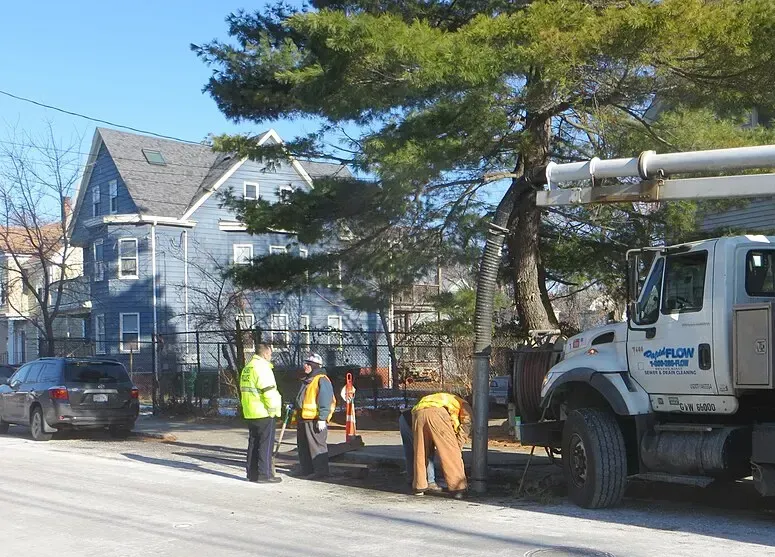
Hydro jetting sends high-pressure water through the line to scour out grease, sludge and roots.
Jetting is a cleaning tool, not a repair. It won't lift a belly or close a crack, and roots that came in through a bad joint will come back through that same joint. On fragile pipe like old Orangeburg, aggressive jetting can make damage worse.
Repair or replace the line?
The camera usually answers this.
- Spot repair makes sense when one joint or one short section is bad and the rest of the pipe looks sound. The contractor digs at the marked spot, cuts out the damage and couples in new pipe.
- Section replacement fits when a belly runs several feet or roots have gotten into a stretch of joints.
- Full replacement is the better call when the whole run is old clay tile or Orangeburg. Patching one spot on failing pipe tends to move the problem a few feet down the line.
Most septic lines are shallow enough that open digging is practical. If yours runs under concrete, ask about options.
Some line work, especially near the tank or on the field side, can call for a permit from Iredell County Environmental Health. The contractor should tell you before starting whether your job needs one.
What drives the price
There's no honest flat rate for line repair. The price depends on:
- How long the damaged section is and how deep it runs
- What's on top of it: lawn, gravel, concrete, landscaping
- Whether the camera finds one problem or several
- Putting the yard back afterward
Our septic pumping cost guide walks through how septic pricing works in general. Your real number comes from a free visit and a written quote.
Questions to ask before you approve line work
- Can I see the camera footage?
- Where exactly is the problem, and how deep?
- Will a spot repair last, or is the rest of the line near the end too?
- Is a baffle at the tank part of the problem? (That part falls under septic repair.)
- If the field side is involved, is it the line or the drain field itself?
Homes around Statesville, Troutman and Harmony with big trees near the line tend to see more root trouble, so mention any when you call.
Questions people ask
How do I know if it's the line and not the tank?
Timing is a good clue. If the tank was pumped recently and drains are still slow or backing up, the line between the house and tank is a strong suspect. When the tank is opened and the level is normal while the house is backing up, the blockage is upstream. A camera inspection from the cleanout confirms it.
Can roots be removed for good?
Clearing roots helps for a while, but they come back through the same joint. The lasting fix is replacing the damaged section with solid pipe and tight joints.
Will my yard be torn up?
Less than you might expect when the problem is located first. A camera with a locator lets the contractor dig only at the bad spot.
Is a slow drain in one bathroom a sewer line problem?
Usually not. One slow fixture is usually a clog in its own drain. When every drain slows down together, or toilets gurgle when the washer drains, the main line or the septic system is more likely. If sewage is backing up right now, see our emergency septic service page.